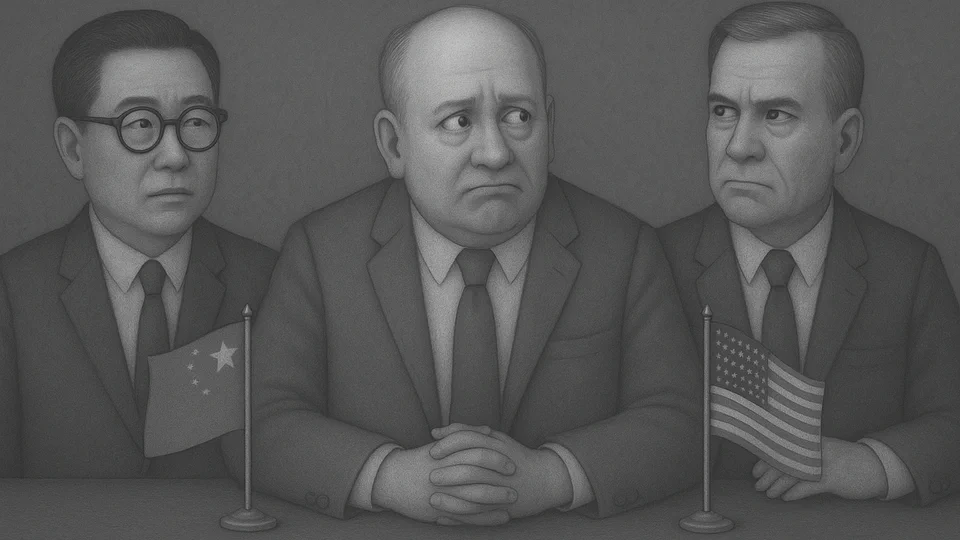
The past decade of hedging has been productive, even impressive, but it cannot last indefinitely. Eventually the overlap will vanish, and Seoul's two strategic paths will diverge for good. Korea will have to choose.
For the past three decades, the notion that North Korea’s nuclear weapons are about survival, made sense. First, they offset the vast conventional superiority of the United States and South Korea. Second, in light of the steadily dropping number of states in the Axis of Evil, they effectively deterred any attempt at regime change. Over the last year, survival seems less of a priority.
South Korea is currently in final negotiations with the United States on a deal that could reshape the balance of power in the Indo-Pacific: the construction of nuclear-powered submarines. What began as a diplomatic coup — Washington’s agreement in principle to support Seoul’s acquisition — has become bogged down in one deceptively simple question: where will they be built?
After 20 years, APEC returned to Korea, but it feels different. Leaders arrived in Gyeongju for the first Korean-hosted summit since Busan 2005, but the optimism that defined APEC twenty years ago has vanished. The hallways are full, the cameras are flashing, yet something vital has gone missing.
Asia’s future will be scripted with the fate of two trilaterals — and South Korea sits at the center of both. The first is the U.S.–Korea–Japan partnership (USKJ), the most explicit security alignment in East Asia. The second is the China–Korea–Japan (CKJ) partnership, a quieter but increasingly consequential alignment built on trade, supply chains, and monetary coordination.
South Korea’s bid for Canada’s submarine project raises a provocative question for Australia: if Canada and Korea can build a modern, sovereign, conventional submarine fleet together, why can’t we get in on it too?
It’s now in all the media. Lee Jae-myung will meet Donald Trump and Xi Jinping next week. Both are billed as state visits; only one will function as one. The first will be a circus, the second will be a summit. The difference could not be starker.
APEC was the fruit yogurt of multilateralism. An unnatural panoply of fruits from across the region — summits, declarations, handshakes and hesitatingly hilarious national costume photo shoots.
There is an inevitable fate that portends all small-to-mid-sized states adjacent to great powers—particularly those that (a) hold territory considered to be strategically relevant; (b) are heavily influenced by or controlled by a perceived opponent to the adjacent state; and (c) are heavily influenced by or controlled by a state in relative decline.
George W. Bush, Nicolas Sarkozy, Therea May, Bill Gates, John Hennessy, Larry Ellison, and George Soros - virtually every target of an Alex Jones conspiracy alert - has spoken there. And this year, it was Justin Trudeau’s turn.